How to Hook Up a Countertop Dishwasher to a Shallow Apartment Sink: Easy Step‑by‑Step Guide for Renters
Introduction
This guide explains how a renter can install a compact countertop dishwasher in a small kitchen where the sink is shallow and space is limited. Readers will learn how to assess clearance, select the right dishwasher, use a faucet‑to‑hose adapter, and operate the appliance safely without permanent plumbing modifications. The instructions are practical for anyone who wants to save time on hand‑washing while preserving the condition of a rental unit.
What You’ll Need
- Portable countertop dishwasher (e.g., EUHOMY Countertop Dishwasher or COMFEE' Portable Countertop Dishwasher)
- Faucet‑to‑hose adapter compatible with your sink’s removable aerator (e.g., SNUTUYA Faucet Adapter, MINGOR Brass Faucet Adapter, or iFealClear Brass Faucet Adapter Kit)
- Adjustable wrench or gloves (optional, for tighter threads)
- Teflon tape (to ensure a leak‑free seal)
- Measuring tape
- Rolling cart or sturdy tray (to move the dishwasher if countertop space is limited)
Step‑by‑Step Instructions
1. Verify Sink Compatibility and Measure Clearance
Before purchasing any equipment, measure the vertical space between the countertop and the bottom of the upper cabinets. Both the EUHOMY Countertop Dishwasher (dimensions 16.83" × 16.73" × 18.03") and the COMFEE' Portable Countertop Dishwasher require at least 19 inches of vertical clearance. If the clearance is insufficient, place the unit on a rolling cart beside the sink rather than directly on the countertop. This approach avoids damage to cabinets and keeps the appliance stable during operation.
2. Choose the Dishwasher Model That Fits Your Lifestyle
The EUHOMY Countertop Dishwasher offers six programs, a built‑in 5 L water tank, and a quiet 40 dB operation. It is rated 4.4/5.0 from 1,036 reviews and costs $269.99. Its dual‑spray arms and high‑temperature “Baby Care/Heavy Duty” cycle are ideal for sanitizing baby bottles, cookware, and pet accessories.
The COMFEE' Portable Countertop Dishwasher also provides six programs, a 1.32 gal built‑in tank, and a high‑temp hygiene cycle up to 162 °F. It is priced at $289.99 and holds 30+ items, making it suitable for single occupants or small households. Both models can operate in “tank mode” (manual water fill) or be connected directly to a faucet via a hose.
Select the model that best matches your dish‑load volume, noise tolerance, and preferred drying method. For renters who cannot modify plumbing, the tank‑mode capability is essential.
3. Identify the Correct Faucet Adapter
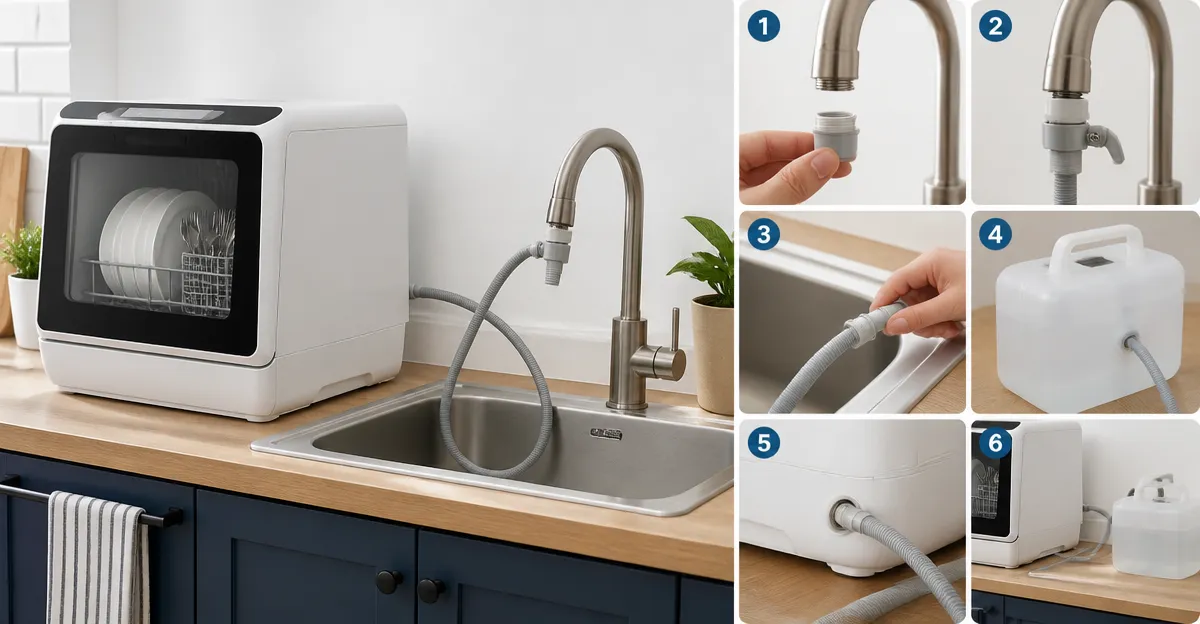
Most apartment sinks have a removable aerator. A faucet adapter converts the aerator’s threads to the standard 3/4" garden‑hose thread required by the dishwasher’s water inlet hose.
- SNUTUYA Faucet Adapter – Made of solid brass, includes a built‑in aerator to prevent splashing when the hose is detached. Priced at $8.09, rated 4.6/5.0 from 854 reviews. Ideal for users who want a permanent, leak‑free connection without removing the adapter each time.
- MINGOR Brass Faucet Adapter – Also solid brass with chrome plating, provides both 55/64" and 3/4" male threads. Priced at $6.79, rating 4.4/5.0 from 1,313 reviews. Includes an extra rubber gasket for smoother hose attachment.
- iFealClear Brass Faucet Adapter Kit – Offers 18 different thread sizes, ensuring compatibility with older or non‑standard faucets. Priced at $18.99, rating 4.4/5.0 from 485 reviews. Best for households with multiple sinks of varying thread dimensions.
Choose the adapter that matches your faucet’s thread size. If you are uncertain, the iFealClear kit provides the most flexibility, while the SNUTUYA adapter is the most straightforward for standard 55/64" male threads.
4. Install the Faucet Adapter
- Turn off the faucet and remove the existing aerator by unscrewing it counter‑clockwise.
- Wrap the male threads of the chosen adapter with Teflon tape (2‑3 wraps) to create a watertight seal.
- Screw the adapter onto the faucet by hand. If the threads feel tight, use a cloth or gloves to avoid skin injury, as recommended by the product instructions.
- Verify that the adapter is firmly seated and that no water leaks when the faucet is turned on briefly.
All three adapters are designed for hand installation; no plumber is required. The solid‑brass construction of both SNUTUYA and MINGOR ensures durability and reduces the risk of corrosion over time.
5. Connect the Dishwasher Water Hose
- Locate the dishwasher’s water inlet hose (typically a short, flexible hose with a 3/4" male thread).
- Attach the hose to the adapter’s female thread. Tighten by hand until snug; avoid over‑tightening to prevent thread damage.
- If the connection feels loose, apply a second layer of Teflon tape or use the extra rubber gasket supplied with the MINGOR adapter.
Once connected, the hose provides a direct water supply, eliminating the need to fill the built‑in tank for each cycle. However, the tank mode remains available for apartments where the faucet is shared or water pressure is low.
6. Position the Dishwasher and Secure Power
Place the dishwasher on a stable, level surface. Ensure there is at least a 19 inches gap between the countertop edge and the nearest cabinet to allow the door to open fully. Plug the unit into a grounded outlet; both EUHOMY and COMFEE' models require a standard 120 V AC outlet. If the outlet is behind the sink cabinet, use a short extension cord rated for kitchen appliances.
7. Fill the Water Tank (If Using Tank Mode)
If you prefer not to connect the hose permanently, fill the dishwasher’s built‑in tank:
- Remove the tank cap and pour water until the automatic water‑level indicator clicks three times (EUHOMY) or the beeping sound stops (COMFEE').
- Use a pitcher provided with the dishwasher or a clean container. The EUHOMY tank holds 5 L; the COMFEE' tank holds 1.32 gal, both sufficient for a standard load.
Filling the tank manually conserves water in apartments with low water pressure and eliminates the need for a continuous faucet connection.
8. Select a Wash Program and Start the Cycle
Load dishes according to the manufacturer’s rack guidelines. For heavy‑soiled pots, choose the “Baby Care/Heavy Duty” (EUHOMY) or “Hygiene” (COMFEE') cycle, which heats water above 160 °F for thorough sanitization. For lightly soiled plates, the “Fast” (EUHOMY) or “Rapid” (COMFEE') cycle completes in under 30 minutes, saving both time and energy.
Press the start button and monitor the progress. Both models emit a three‑ding signal when the cycle finishes, indicating that the drying phase (if selected) has also completed.
9. Drain and Store the Dishwasher
When the cycle ends, either let the built‑in drainage hose flow into the sink or position the drain hose into a bucket if the sink is occupied. The EUHOMY model offers a 73‑hour ventilation mode for extended drying; the COMFEE' model includes an “Air Refresh” function that circulates air to prevent moisture buildup.
After draining, wipe the exterior with a damp cloth and store the unit on the rolling cart if countertop space is needed for other tasks.
Tips & Pro Tips
- Seal with Teflon tape – Even though the adapters are brass, a thin layer of tape prevents micro‑leaks that could damage flooring.
- Use hot tap water for tank fills – Starting with warm water reduces the heating time of the dishwasher, lowering energy consumption.
- Rinse heavily soiled items – Both EUHOMY and COMFEE' perform best when food residue is removed; a quick spray from the sink prevents clogs.
- Check water pressure – The COMFEE' hose operates best between 0.04‑1.0 MPa. If pressure is low, rely on the built‑in tank instead of a continuous hose.
- Maintain the adapter – Periodically remove the adapter, clean any mineral buildup, and re‑apply Teflon tape to sustain a leak‑free connection.
Troubleshooting
| Problem | Possible Cause | Solution |
|---|---|---|
| Water leaks at the faucet connection | Improper thread seal or damaged gasket | Turn off water, remove adapter, re‑apply Teflon tape, and ensure the rubber gasket (if using MINGOR) is correctly seated. |
| Dishwasher does not fill | Hose not fully seated or water inlet valve closed | Confirm hose is tightly connected to the adapter and that the faucet is fully open. |
| Drying cycle not activating | Selected program does not include drying (e.g., EUHOMY Fruit mode) or power button held too briefly | Choose a program with drying, or hold the dry button for three seconds as described in the manual. |
| Excessive noise | Improper leveling or items hitting the spray arms | Adjust the dishwasher on a level surface and rearrange dishes to avoid contact with the rotating arms. |
Conclusion
Renters can enjoy the convenience of a countertop dishwasher without permanent plumbing modifications by following this guide. Measuring clearance, selecting a suitable dishwasher, installing a solid‑brass faucet adapter, and using the built‑in water tank when necessary provide a reliable, leak‑free solution. With careful placement and regular maintenance, the appliance will deliver clean, sanitized dishes while preserving the integrity of a shallow apartment sink.
Products Mentioned in This Guide
Frequently Asked Questions
Can I install a countertop dishwasher in a shallow apartment sink without permanent plumbing?
Yes, using a faucet‑to‑hose adapter you can connect the dishwasher to the sink’s removable aerator, avoiding any permanent modifications.
What clearance do I need under the countertop for a portable dishwasher?
Allow at least 2‑3 inches of vertical space for the dishwasher’s water inlet hose and drainage pipe, plus room for the door to open fully.
Which type of faucet adapter works best for a shallow sink?
A universal faucet‑to‑hose adapter that screws onto the aerator threads and includes a quick‑connect hose is ideal for most shallow sinks.
Do I need a separate drain for the countertop dishwasher?
No, the dishwasher’s drain hose can be placed into the sink’s basin or a nearby utility sink for gravity drainage.
Is it safe to run a countertop dishwasher on a rented kitchen’s electrical outlet?
Yes, as long as the outlet is grounded, rated for 120 V, and the dishwasher’s power cord does not overload the circuit.